| The Social Insect Lab |
 |
people |
projects |
publications |
teaching |
in the news |
Uni of AZ |

EEB |
Current research in the Social Insect Lab
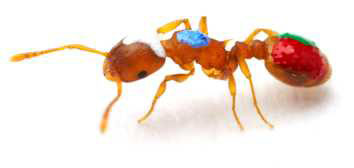
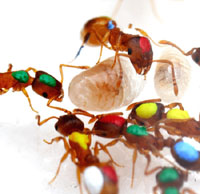
Research in our lab focuses on three main areas, all using social insects as model systems. First, the emergence of complexity and increased efficiency through collective behavior; second, effects of scaling in complex systems; and third, the role of learning and individual variability for collective success. We use a combination of empirical lab studies and theoretical approaches, such as individual-based simulations, as well as fieldwork. Our main model systems are the bumble bee Bombus impatiens and various species of ants, recently primarily the ‘rock ants’ Temnothorax rugatulus and Cephalotes rohweri. Some example studies are described in more detail below.
If you are interested in joining the group and looking for a project, please contact me (dornhaus email.arizona.edu) directly. email.arizona.edu) directly.Evolution of collective behavior Why division of labor in groups? What is the adaptive benefit of worker polymorphism in bumble bees? Optimal allocation of defense specialists Task allocation mechanisms and collective performance Mechanisms of collective behavior Polydomy in ants and coordination between nests Spatial order in bumble bee nests Learning and task performance Scaling in insect colonies Colony size, density, and energy use Other topics Individual vs. social optimal search patterns |
|
What are the benefits of division of labor? Anna Dornhaus |
The ecological success of social insects is often attributed to an increase in efficiency achieved through division of labor between workers in a colony. However, the important assumption that specialists are indeed more efficient at their work than generalist individuals – the “Jack-of-all-trades is master of none” hypothesis – has rarely been tested. Using individually marked workers of the ant Temnothorax albipennis, I could show that individual efficiency is not predicted by how specialized workers were on a task for several tasks. Worker efficiency is also not consistently predicted by that worker’s overall activity or delay to begin the task (Dornhaus 2008). My results demonstrate that in an ant species without morphologically differentiated worker castes, workers may nevertheless differ in their ability to perform different tasks. Surprisingly, this variation is not utilized by the colony – worker allocation to tasks is unrelated to their ability to perform them. Interestingly, it is also common to see many workers apparently perform no tasks at all (Dornhaus et al. 2008). What, then, are the adaptive benefits of behavioral specialization, and why do workers choose tasks without regard for whether they can perform them well? We are still far from an understanding of the adaptive benefits of division of labor in social insects. |
|
What is the adaptive benefit of worker polymorphism in bumble bees? Anna Dornhaus, Margaret Couvillon, Jenny Jandt, Nhi Duong |
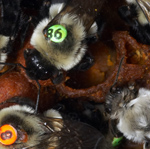
Even within the same colony, bumble bees produce workers of strongly varying sizes concurrently (Couvillon et al. 2010). What is the adaptive function of this size variation? We are testing the hypotheses that (1) different-sized workers are adaptive as specialists for different tasks (perhaps not, in prep, even though body size is clearly predictive of what tasks workers perform: Jandt et al. 2009, Jandt & Dornhaus 2009); (2) that they are the result of a trade-off between cheap, low-quality and expensive, high-quality workers (perhaps, in prep); that (3) small workers have other benefits besides being cheaper to produce, even if they do not perform any task well (they may live longer under conditions of dearth, Couvillon & Dornhaus 2010); or (4) that they are the non-adaptive result of a biased larval care system. We have also found that small workers do not seem to be adapted to flying at hotter temperatures (Couvillon et al. 2010). There is however some evidence that colonies which do have workers of varying body size perform better at some tasks (in prep). |
|
Optimal defense allocation Scott Powell, Anna Dornhaus 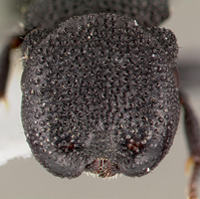 |
Division of labor occurs at all levels of biological organization: for example, cells in a multi-cellular organism just as workers in a social insect colony may specialize on particular tasks. Such specialization can lead to morphological differentiation, and thus to evolutionary innovation. What environmental or social conditions favor such specialization of components, and what system-level organization is needed to reap the benefits of such specialization? The objective of this project is to develop a new, quantitative understanding of the contribution of morphologically distinct specialists to group success. ‘Turtle ants’ (Cephalotes rohweri) will be used as model system - these ants produce two types of workers, one of which is a highly specialized defense soldier with a plate-shaped head, used to block nest entrances. Because of their costs and inflexibility, the production of specialists is limited. Defense of the colony may thus crucially depend on effective allocation of specialists to the right place at the right time. The project will investigate how this dynamic allocation takes place, and thus how the ant society trades-off risk and resources; it will investigate the contribution of specialists to colony fitness; and a model will be developed to determine the optimal strategy for distributing specialists in a variable work environment. The project will thus offer new insights on important questions about the evolution of specialization. In addition, because it focuses on defense specialists, it will have implications for optimal allocation of defense resources in any system. The results of this project will serve not only to increase understanding of the evolution of specialization, but also help engineers design improved distributed problem solving algorithms, for example in collective robotics. |
|
Task allocation mechanisms and colony-level performance Anna Dornhaus, Franziska Kluegl 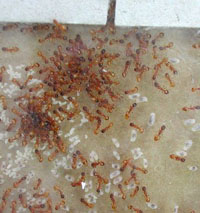 |
In spite of much research on potential mechanisms for allocating tasks to workers, very little is known on how different such mechanisms impact colony-level efficiency. We are using a computational model to predict which mechanisms, and what degree of specialization, would optimize colony function under different conditions. This model will generate predictions as to which species should be expected to display a high degree of individual specialization, and also whether colony size or environmental variability is more likely to influence this. Results from this project will also be useful for engineers, for choosing the appropriate task allocation mechanism in artificial complex systems, such as distributed computing networks. |
|
Coordination between nests of a polydomous ant colony Tuan Cao, Michele Lanan, Amelie Schmolke, Anna Dornhaus 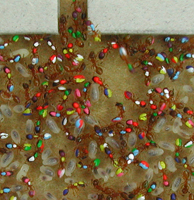 |
We are studying the interactions and the exchange of workers, brood, and food between the nests of polydomous colonies. |
|
Spatial Organization of Bumble Bees (Bombus impatiens) Inside the Nest Jenny Jandt, Margaret Couvillon, Anna Dornhaus 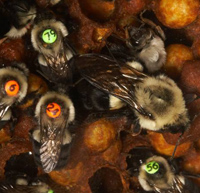 |
We show that in colonies of bumble bees, Bombus impatiens (1) workers tend to remain at a specific distance from the colony center independent of their age, and thus the spatial pattern of workers on the nest is not random; (2) smaller individuals maintain smaller spatial zones and tend to be closer to the center; and (3) individuals who are more likely to perform brood care tend to remain in the center of the nest, whereas foragers are more often found on the periphery of the nest when not foraging (Jandt & Dornhaus 2009) . As brood is present in all areas of the nest, this leads to larvae in the center of the nest being fed more frequently than those in the periphery. As a consequence of this, (4) larvae in the periphery of the nest remain smaller and form smaller workers. This is a mechanism creating worker polymorphism (Couvillon & Dornhaus 2009). What is the mechanism creating spatial preferences in workers? Ongoing studies will address this. |
|
Worker performance and learning Anna Dornhaus, Alex Walton 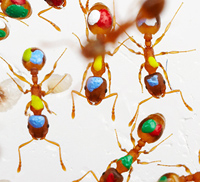 |
Do specialized workers learn to perform their 'specialty task' better, or do workers choose to perform tasks at which they are already good? We studied the relationship between preference for tasks and performance of these tasks, and how differences among workers emerge in each of these traits. In particular, we marked naive individual workers of Temnothorax albipennis and quantified their performance at brood transports in colony emigrations and transports of nest material (sand grains). We tested whether performance is affected by experience (learning), and whether learning increases or decreases intrinsic performance differences among workers. We will also test whether workers increase their preference for tasks that they perform well. |
|
Effects of colony size on collective behavior Tuan Cao, Anna Dornhaus 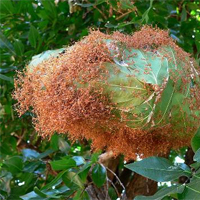 |
We are interested in effects of scaling on superorganisms and the emergence of complexity at higher colony sizes, with a particular focus on determining the effect of numbers of workers and mass involved. For example, larger colonies are said to have more complex collective behavior. Indeed we find that colony size affects collective decision-making (Dornhaus & Franks 2006); on the other hand, its effects on division of labor may differ between species: in the ant Temnothorax albipennis, workers in larger colonies are not more specialized (Dornhaus et al. 2009)
, and workload may actually be more unevenly distributed in smaller colonies Dornhaus et al. 2008).
In unitary organisms, it is often found that animals with larger body sizes have lower mass-specific metabolic rate. Interestingly, we find the same for ant colonies, 'superorganisms'. We also find that colony-level metabolic rate is dependent on the worker density in the nest (Cao & Dornhaus 2008). Ongoing studies are investigating how effects of colony size may be mediated by individual body size differences, how group size affects the network of interactions in the colony, and how it affects individual behaviors. See our ants on video. |
|
Individual search... rules! Amelie Schmolke, Anna Dornhaus 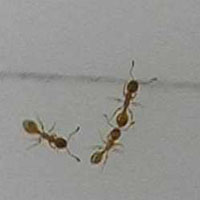 |
While recruitment to known food sources by ants has been studied extensively, it is not as clear how individuals discover new food sources. Moreover, the search strategies used by ants lacking mass recruitment are not well known. We approach these questions by characterizing the foraging behavior of Temnothorax rugatulus ants. We found that the search path of T. rugatulus foragers can be described as a random walk, i.e. the ants show no significant bias in direction choice at any point of their (unsuccessful) search. This is also reflected in the area the foragers cover during their search: foragers visit wide areas, and their space use is not influenced by the areas visited by their nest mates. Hence, T. rugatulus foragers act independently on their food search and do not divide up the nest surroundings into individual search areas. While foragers act individually outside the nest, the nutritional status of the colony determines the number of ants leaving the nest to forage. The longer time a colony remains without food intake, the more individuals will go out to search for food. Is this strategy of food search optimal for small colonies? And does it depend on the distribution of food sources the ants tend to exploit? We introduce an individual-based model of ant foraging that allows the comparison of different strategies with respect to colony-level foraging success. |
|
Collective decision-making in ants and populations of neurons James Marshall, Rafal Bogacz, Anna Dornhaus, Robert Planque, Tim Kovacs, Nigel Franks 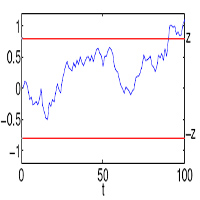 |
The problem of how to compromise between speed and accuracy in decision-making faces organisms at many levels of biological complexity. Striking parallels are evident between decision making in primate brains an collective decision-making in social insect colonies: in both systems separate populations accumulate evidence for alternative choices, when one population reaches a threshold a decision is made, and this threshold may be varied to compromise between the speed and accuracy of decision-making. We analyze the properties of both of these systems, and show in which ways the ant collective decision making system may be statistically optimal (Marshall et al. 2009). |
|
Parasite-host relatedness and other host characteristics in ant social parasitism Ming Huang, Anna Dornhaus 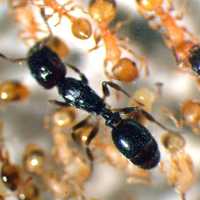 |
We used data from published literature to characterize commonalities and differences in host choice between the four major types of ant social parasitism: xenobiosis, temporary parasitism, dulosis, and inquilinism. Our analysis shows that xenobiotic parasites tend to have single or multiple host species that are very distantly related and have medium to large host colonies. Temporary parasites tend to have multiple host species that are very closely related and have medium host colonies. Dulotic parasites tend to have multiple host species that are slightly less related and have host colonies of any size. Lastly, inquiline parasites tend to have single host species that are very closely related and have medium host colonies. In addition, a parasite tends to be very closely related to its host when the parasite has a single host species or large host colony sizes (Huang & Dornhaus 2008). |
 |